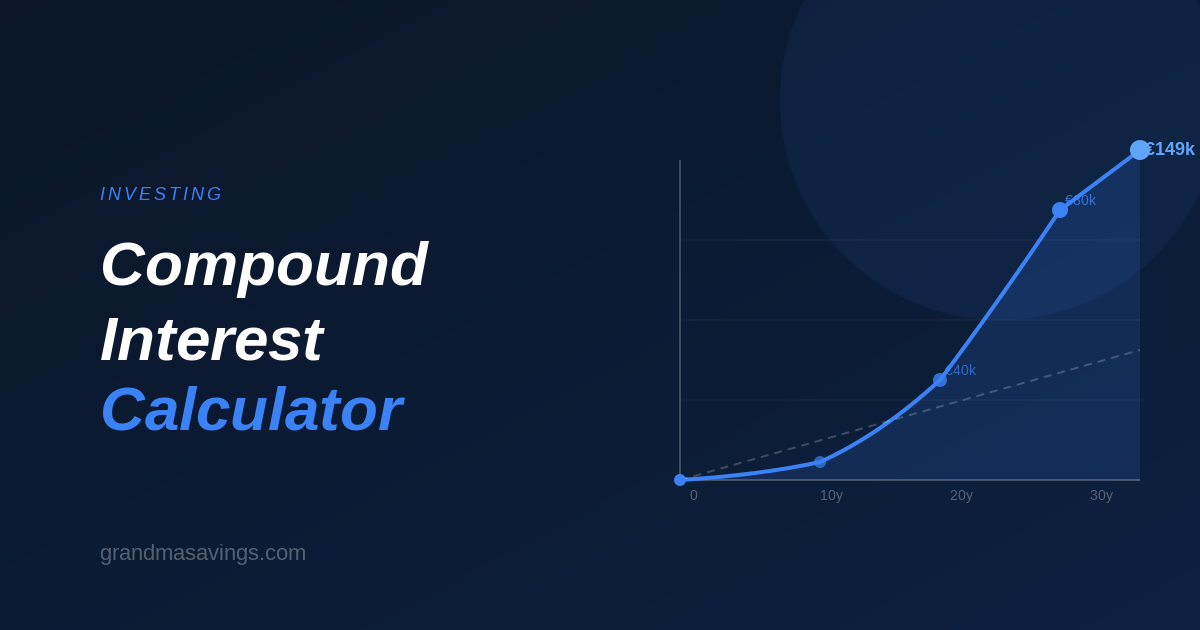
Compound Interest Calculator: Why Time Is More Valuable Than Money
Compound interest is the most powerful force in personal finance — and the most misunderstood. This guide explains exactly how it works, how to use a compound interest calculator to project your savings, and why starting 10 years earlier beats doubling your contributions.
Albert Einstein reportedly called compound interest "the eighth wonder of the world." Whether or not he said it, the sentiment is mathematically accurate. Compound interest is the mechanism by which small, consistent investments become large sums over time — and a compound interest calculator makes this invisible process visible.
The Difference Between Simple and Compound Interest
Simple interest grows linearly: €10,000 at 5% earns €500/year, every year, on the original principal only.
Compound interest grows exponentially: €10,000 at 5% earns €500 in year 1, then 5% on €10,500 in year 2 (€525), then 5% on €11,025 in year 3 (€551), and so on. You earn interest on your interest.
The difference looks trivial in year 1. After 30 years, it's enormous.
After 30 years at 5%:
- Simple interest: €25,000 (€10,000 + €500 × 30 years)
- Compound interest: €43,219 — 73% more
After 40 years at 7%:
- Simple interest: €38,000
- Compound interest: €149,745 — 294% more
This is not a trick. It's arithmetic. And it's why time matters so much more than almost any other variable in investing.
How the Compound Interest Calculator Works
The calculator uses this formula:
A = P(1 + r/n)^(nt) + PMT × [(1 + r/n)^(nt) - 1] / (r/n)
Where:
- A = final amount
- P = principal (starting amount)
- r = annual interest rate (as a decimal)
- n = compounding frequency per year
- t = time in years
- PMT = regular contribution per period
You don't need to calculate this by hand. Enter the numbers and see the result instantly.
The Inputs That Matter Most
Starting Amount (Principal)
How much you have today. Even €0 works — if you start from nothing but contribute regularly, compound growth still applies to every contribution from the moment it's invested.
Regular Contribution
The amount you add monthly (or annually). This is often more impactful than your starting amount over long time horizons, because consistent contributions mean you're always adding new principal to compound.
Annual Interest Rate
The expected annual return on your investment. Rough historical benchmarks:
- Global stock market index (e.g., MSCI World): 7–8% annually (after inflation, long-term average)
- Conservative portfolio (60% stocks, 40% bonds): 5–6%
- High-yield savings account (current, 2026): 4–5%
- Standard savings account: 0.3–0.8%
Use conservative rates for planning. Markets don't deliver exactly 7% every year — some years are -20%, some are +25% — but long-term averages have been consistent over 100+ years of data.
Compounding Frequency
How often interest is calculated and added to the principal:
- Annually (once per year) — common for many savings products
- Quarterly — some bonds and CDs
- Monthly — most savings accounts and investment accounts
- Daily — some high-yield savings accounts
More frequent compounding = slightly higher final amount. Monthly vs. annual compounding on a €10,000 investment over 20 years at 6%: the monthly earns about €2,000 more. Meaningful, but not the most important variable.
Time Horizon
This is the single most powerful input. Run the calculator and compare:
- €300/month for 30 years at 7%: €340,000
- €300/month for 40 years at 7%: €786,000
Ten extra years — without increasing contributions — more than doubles the result. This is the core message of compound interest: time is the scarce resource, not money.
The "Rule of 72"
A simple mental shortcut: divide 72 by your annual return rate to find how many years it takes to double your money.
- At 6%: 72 ÷ 6 = 12 years to double
- At 8%: 72 ÷ 8 = 9 years to double
- At 4%: 72 ÷ 4 = 18 years to double
A €10,000 investment at 7% becomes €20,000 after ~10 years, €40,000 after ~20 years, €80,000 after ~30 years. This doubling pattern is compound interest made visible.
Three Counter-Intuitive Results the Calculator Reveals
1. Early years barely move the needle
The first 10 years of a 30-year investment account for only about 15% of the final value. The last 10 years account for roughly 40%. This feels wrong — but it's why stopping contributions early is catastrophic and why the last decade before retirement is so powerful.
2. A higher rate beats more contributions (up to a point)
Increasing your return from 5% to 7% on a 30-year investment of €200/month changes the outcome from €167,000 to €243,000 — a difference of €76,000, achieved with zero additional money contributed. This is why investment fees (which reduce your effective return) matter so much over long time horizons.
3. Taxes and fees dramatically change the result
A 1% annual management fee on an investment that returns 7% gives you an effective 6% return. On €200/month over 30 years, that 1% fee costs you approximately €40,000 in final wealth. Low-cost index funds (expense ratios of 0.03–0.20%) capture nearly the full market return.
Practical Applications
Savings goal projection: Enter your savings rate and see when you'll reach a specific target (€20,000 emergency fund, €50,000 down payment, €500,000 retirement).
Investment comparison: Compare two investment options with different return rates side by side. The difference over 20 years is often shocking.
Inflation adjustment: Some calculators allow for an inflation rate. This shows your portfolio's purchasing power in today's money — important because €500,000 in 30 years won't buy what €500,000 buys today.
Debt as negative compound interest: The same calculator works in reverse for debt. At 22% APR, credit card debt doubles in about 3.3 years (72 ÷ 22). Every year you carry the balance, compound interest works against you.
The Simplest Thing You Can Do Today
Open the calculator. Enter your current savings, your monthly contribution (even if it's small), and 7% over 30 years.
The number you see is an approximation of what consistent, patient investing looks like over time. Adjust the contribution amount until the result matches your goals. That's your monthly savings target.
Open the Compound Interest Calculator →
Compound interest rewards patience and consistency above all else. The calculator makes that abstract truth concrete.
Found this useful? Share it