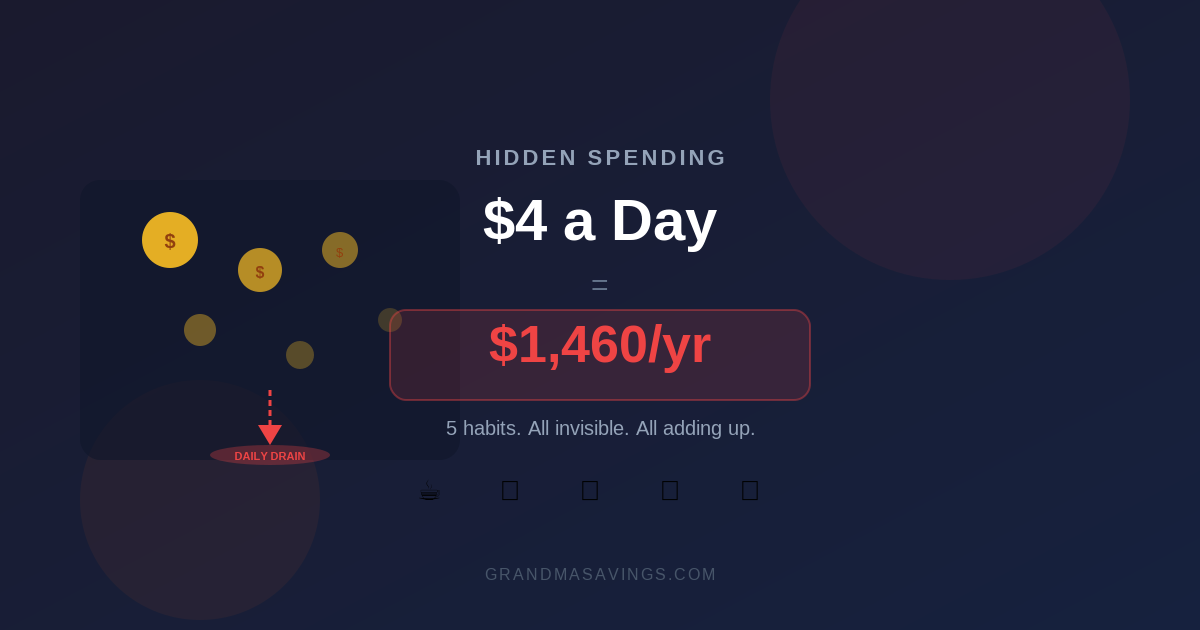
5 Daily Habits That Are Quietly Draining $1,460 From Your Savings Every Year
You're not bad with money. You just haven't done this math yet. Five small, invisible spending habits that cost most people over a thousand dollars a year — and the simple way to stop.
You checked your balance last week. It looked fine. You check it now. Somehow it's lower. You didn't buy anything big. No vacation, no new gadget, no emergency. The money just… went.
This isn't a mystery. It's math — specifically, the math of small daily spending that never feels like a decision because each charge is too small to register.
$4 doesn't feel like money. But $4 a day is $1,460 a year. Every single year.
The Problem: Your Brain Is Wired to Ignore Small Numbers
Behavioral economists call it "the pain of paying." Every purchase involves a small psychological friction — except when the amount is so small it doesn't trigger the system. A $130 dinner registers. A $4.20 coffee doesn't. But 365 coffees at $4.20 is $1,533.
Your brain processes one as a decision and the other as nothing. Both are decisions. One just feels invisible.
This is the ant expense problem: individually harmless, collectively devastating. They don't appear on any single bank statement line that shocks you. They're distributed across the month in amounts too small to question. And they compound — not financially, but behaviorally. Each small spend normalizes the next one.
The 5 Habits — And the Annual Price Tag
Here's what the math actually looks like when you run it for a full year:
1. The daily coffee stop — $4/day → $1,460/year Not "never drink coffee." The issue is the automatic stop — the one you make without thinking, every weekday, plus weekend habit. If it's twice a day on weekdays: $2,920/year. These aren't enjoyment purchases anymore; they're autopilot.
2. Unused subscriptions — avg. $47/month → $564/year The average person has 4–6 active subscriptions they don't use regularly. That streaming service you "might watch something on," the app you downloaded six months ago, the gym app you kept after canceling the gym. $564 a year in services you'd never miss if they disappeared tomorrow.
3. Convenience delivery markups — $6 extra per order × 3/week → $936/year Delivery apps charge 15–30% more than in-store prices, plus service fees, plus tip. The food isn't more expensive. The convenience fee is. Three orders a week at $6 extra each: $936/year for the same meal you'd have paid less for in person.
4. Bank fees and low-balance charges — avg. $12/month → $144/year Monthly maintenance fees on checking accounts you could switch out of. Foreign transaction fees. ATM fees at non-network machines. None of these are large. Together they average $144/year for most people — paid to a bank for the privilege of holding your money.
5. Impulse digital purchases — avg. $35/month → $420/year In-app purchases, one-click Amazon buys under $20, digital games you play twice, browser extension purchases. Each is a micro-decision that didn't involve opening your wallet. Total for the year: $420 spent on things you could not name two weeks after buying.
Combined annual total: ~$3,524
That's not a bad month. That's the systematic, invisible drain running every single year.
The Solution: Name It, Then Decide
The fix isn't willpower. It's visibility.
You can't resist a decision you don't know you're making. The goal is to move these from "autopilot" to "conscious choice" — even briefly. Most people, when they actually see the math, keep some and cut others. They don't eliminate joy. They eliminate the spending they didn't even know was happening.
Step 1: Run a 30-day audit. Pull every transaction under $20 from the last month. Categorize them. Calculate the annual equivalent of each category. This takes 20 minutes and is usually mildly alarming.
Step 2: Apply the $1,000 test. For each recurring small expense: "If this cost $1,000/year, would I still pay for it?" That IS the annual cost. If the answer is no, cancel it.
Step 3: Add friction to autopilot spending. Delete saved payment info from food delivery apps. Move your coffee budget to a separate weekly cash envelope. Make the unconscious spending slightly conscious again.
Step 4: Redirect what you find. Every dollar you recover from invisible spending is a dollar that can go to your emergency fund, debt payoff, or savings goal. $200/month redirected compounds significantly over years.
The Savings Tracker logs every expense by category so you can see exactly where your money goes each month — including the small stuff that never shows up clearly anywhere else.
Found this useful? Share it