Debt Consolidation Calculator: Is It Worth Combining Your Debts?
Debt consolidation sounds appealing — one payment, lower rate, less stress. But it's not always the right move. A debt consolidation calculator shows whether you'll actually save money or just rearrange the problem.
Debt consolidation is one of the most misunderstood strategies in personal finance. Done correctly, it saves real money and simplifies repayment. Done incorrectly, it extends your debt timeline, increases total interest paid, and gives you a false sense of progress while the problem continues.
A debt consolidation calculator cuts through the marketing and shows you the actual math.
What Debt Consolidation Actually Means
Debt consolidation combines multiple debts into a single loan — typically with a lower interest rate, a single monthly payment, and a fixed payoff date.
Common methods:
- Personal loan: borrow a lump sum at a fixed rate, use it to pay off multiple cards
- Balance transfer credit card: move card balances to a 0% intro APR card (usually 12–21 months)
- Home equity loan or HELOC: use your home's equity to pay off unsecured debt (higher risk — your home is collateral)
- Debt management plan (DMP): through a nonprofit credit counseling agency, not a loan
The calculator applies specifically to the first two — taking out a new loan at a lower rate to replace higher-rate debt.
The Core Calculation: Does It Actually Save Money?
The only question that matters is: will you pay less in total interest?
To find out, the calculator compares:
- Scenario A: paying off current debts individually at their current rates
- Scenario B: consolidating into a new loan at a lower rate
Example:
Current debts:
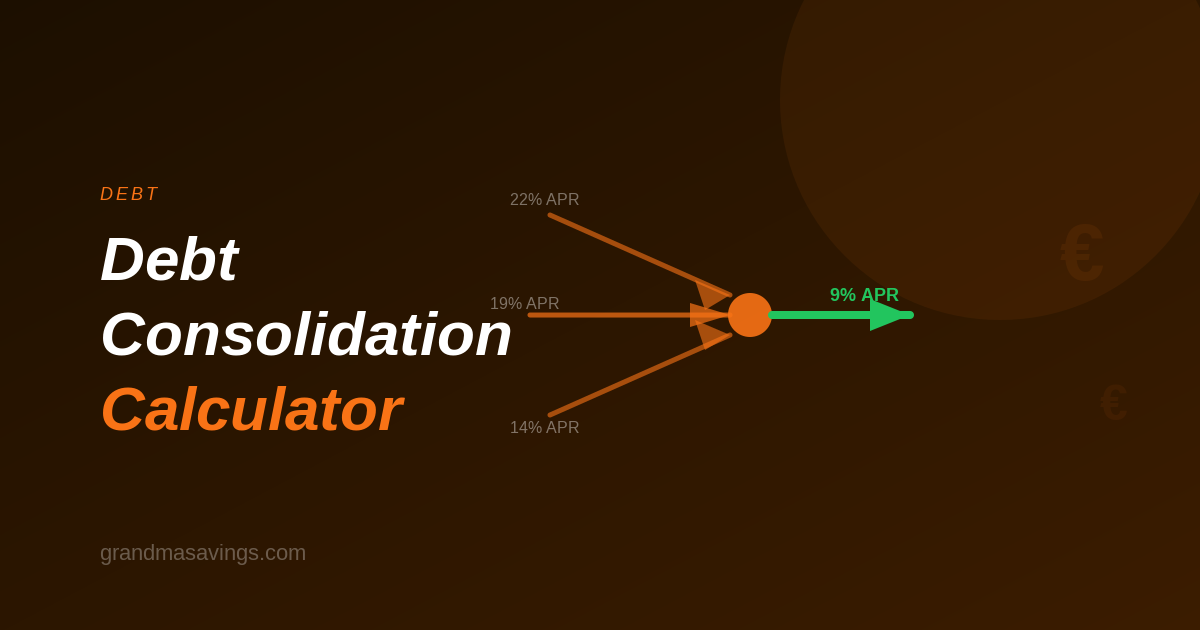
- Credit card 1: €4,000 at 22% APR, minimum €80/month
- Credit card 2: €2,500 at 19% APR, minimum €50/month
- Personal loan: €3,500 at 14% APR, minimum €90/month
- Total: €10,000 debt, €220/month minimum
Consolidated personal loan: €10,000 at 9% APR, 48-month term = €248/month
Wait — the payment went up? Yes, by €28/month. But:
- Time to pay off (paying minimums): 8+ years, €6,800+ in interest
- Time to pay off (consolidation loan): 48 months, €1,905 in interest
The consolidation costs €28 more per month but saves nearly €5,000 in total interest and eliminates the debt 4–5 years faster.
This is what the calculator shows you — not just the monthly payment, but the total cost.
When Consolidation Makes Sense
✅ It makes sense when:
- Your consolidation rate is significantly lower than your current rates (at least 4–5% lower)
- You're committed to not adding new debt to the paid-off cards
- You want a fixed payoff date (personal loans have set terms)
- Your credit score has improved since you took on the debt (better rates available now)
❌ It doesn't make sense when:
- You can only qualify for a rate close to what you're already paying
- The new loan term is so long that total interest exceeds what you'd pay on current debts
- You'll continue using the credit cards you pay off (this is how people end up with more debt than they started with)
- You'd be converting unsecured debt to secured debt (e.g., using home equity) without fully understanding the risk
The Balance Transfer Trap
0% balance transfer offers are appealing — and can be excellent tools — but they come with critical details:
Transfer fee: Most cards charge 3–5% of the transferred balance. On €10,000, that's €300–€500 upfront.
Promotional period expiration: After 12–21 months, the rate often jumps to 20%+. If you haven't paid off the balance by then, you're back where you started — or worse.
New purchases: Many 0% cards apply payments to the 0% balance first. Any new purchases you make on the card may accrue interest immediately. Keep the card for balance payoff only.
The calculator can account for these — enter the transfer fee as an additional cost and set the rate to whatever it becomes after the promotional period if you might not pay it off in time.
The Debt Avalanche vs. Consolidation Decision
Before consolidating, run the debt avalanche numbers: pay minimums on everything except the highest-rate debt, throw every extra euro at that one. Once it's gone, attack the next highest.
For many people, the avalanche is more effective than consolidation because:
- No new loan application (no credit inquiry, no origination fees)
- No risk of adding to paid-off cards
- Total interest paid is often comparable or lower
The debt consolidation calculator lets you compare: avalanche on current debts vs. consolidation loan. Pick whichever total interest figure is lower.
How to Use the Calculator Step by Step
-
List every debt you're considering consolidating: balance, interest rate, minimum payment
-
Enter the proposed consolidation loan terms: rate, term, any origination fee (typically 1–6% of loan amount, deducted from the funds received)
-
Compare the two outputs:
- Total interest on current debts (paid as-is)
- Total interest on consolidation loan
-
Factor in behavioral risk: If there's a meaningful chance you'll accumulate new card debt after consolidating, add that risk to your calculation.
-
Check break-even point: How many months until the consolidation savings exceed the origination fee? If it's 18 months into a 48-month loan, you need to commit to holding the loan that long for it to be worth it.
What to Do After You Decide
If you consolidate: Close or reduce the credit limit on the paid-off cards immediately. The temptation to "float" on newly empty credit lines is the number one reason debt consolidation fails. One study found that 70% of people who consolidate credit card debt end up with the same or higher total debt within 5 years.
If you don't consolidate: Set up automatic payments above the minimum on your highest-rate debt. Automation removes the decision fatigue that derails manual debt payoff plans.
Either way, the path forward starts with knowing your exact numbers.
Found this useful? Share it