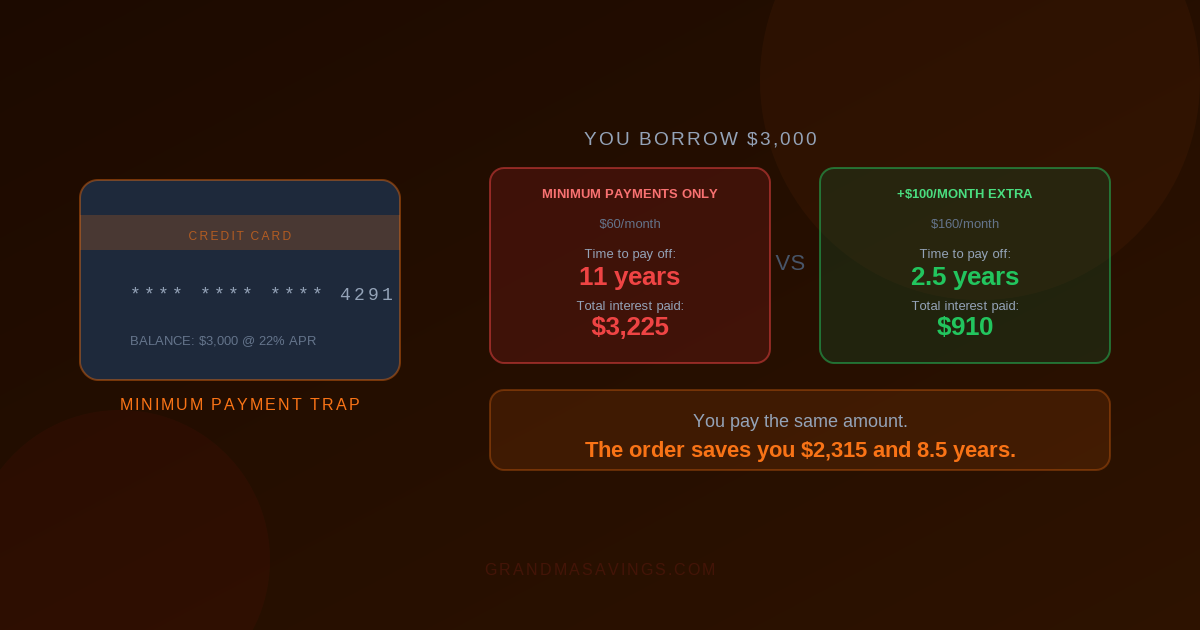
Paying the Minimum on Your Credit Card? You're Paying for It Three Times Over.
A $3,000 credit card balance paid at the minimum costs you $6,200 total and takes 11 years to clear. Here's the exact math — and a faster way out that doesn't require earning more money.
You made the minimum payment last month. It felt responsible — you didn't miss it, you didn't pay late. The balance barely moved. You figured you'd pay more next month when things settle down.
This is exactly what credit card companies design for.
The minimum payment is engineered to keep you paying interest for as long as possible. It's not a kindness. It's a business model.
The Problem: Minimum Payments Are Maximum Profit for Banks
A $3,000 credit card balance at 22% APR. Standard minimum payment: about $60/month (2% of balance).
Here's what actually happens when you pay that minimum every month:
- Time to pay off: 11 years and 4 months
- Total interest paid: $3,225
- Total you pay: $6,225 for $3,000 of stuff
You pay for it twice. Then you pay for part of it a third time. And during those 11 years, you almost certainly add new purchases to the card — resetting the clock, extending the debt, compounding the damage.
The credit card company booked $3,225 in profit from a $3,000 loan they gave you at no risk to themselves, collateralized by nothing, paid back over a decade. That's a 107% total return.
The Agitation: The Minimum Payment Is Designed to Feel Like Progress
The genius of the minimum payment system is that it never hurts enough to create urgency. $60/month is manageable. The balance goes from $3,000 to $2,981 to $2,962 — it's technically going down. You're technically making progress.
What you don't see: of that $60 payment, $55 went to interest and $5 went to principal. The $3,000 balance generates $55 in interest in a single month. Your $60 payment barely outpaces the interest charge.
At this pace, the debt has a half-life of years. And every time you use the card again — even for something small — you undo months of minimum payments.
The Real Cost of "I'll Pay More Next Month"
Let's say you have three cards:
| Card | Balance | APR | Minimum |
|---|---|---|---|
| Card A | $2,500 | 24% | $50 |
| Card B | $1,800 | 19% | $36 |
| Card C | $700 | 15% | $14 |
| Total | $5,000 | — | $100/month |
Paying minimums only:
- Time to clear: 14+ years
- Total interest: $5,800+
- Total paid: ~$10,800 for $5,000 of debt
Adding just $100/month extra — applied to the highest-rate card first (debt avalanche):
- Time to clear: 4 years 2 months
- Total interest: $1,950
- Total paid: ~$6,950
The extra $100/month saves $3,850 in interest and 10 years of debt. Not more income — just a different strategy with the same money.
The Solution: The Debt Avalanche in 3 Steps
You don't need to increase your income to escape this. You need to redirect what you already pay.
Step 1: List every debt with balance, APR, and minimum payment. Total your minimums. This is your baseline — you're already paying this.
Step 2: Find any extra money — even $50/month. That's one fewer delivery order per week. One fewer subscription. One redirected habit. It doesn't have to be dramatic.
Step 3: Pay all minimums, then throw every extra dollar at the highest-rate debt. Not the largest balance. The highest APR. That's where interest is doing the most damage. When that card is cleared, roll its minimum payment onto the next highest rate. The momentum builds.
This is the debt avalanche. It's mathematically optimal — it minimizes total interest paid. The alternative, the debt snowball (smallest balance first), is psychologically easier but costs more interest. Your call — either beats the minimum payment.
What "Paying It Off" Actually Frees Up
When that $2,500 card at 24% is paid off, you've freed up its minimum payment ($50) plus the extra you were throwing at it. That full amount now attacks the next card. And once all cards are clear, that monthly cash is entirely yours — for investing, building the emergency fund, or simply breathing.
The minimum payment doesn't lead there. It's a treadmill. The only way off is to pay more than the minimum, starting with the most expensive debt first.
Use the Debt Consolidation Calculator to see whether consolidating your cards into a single lower-rate loan would save you more than the avalanche — or run both scenarios side by side to pick the winner.
Found this useful? Share it