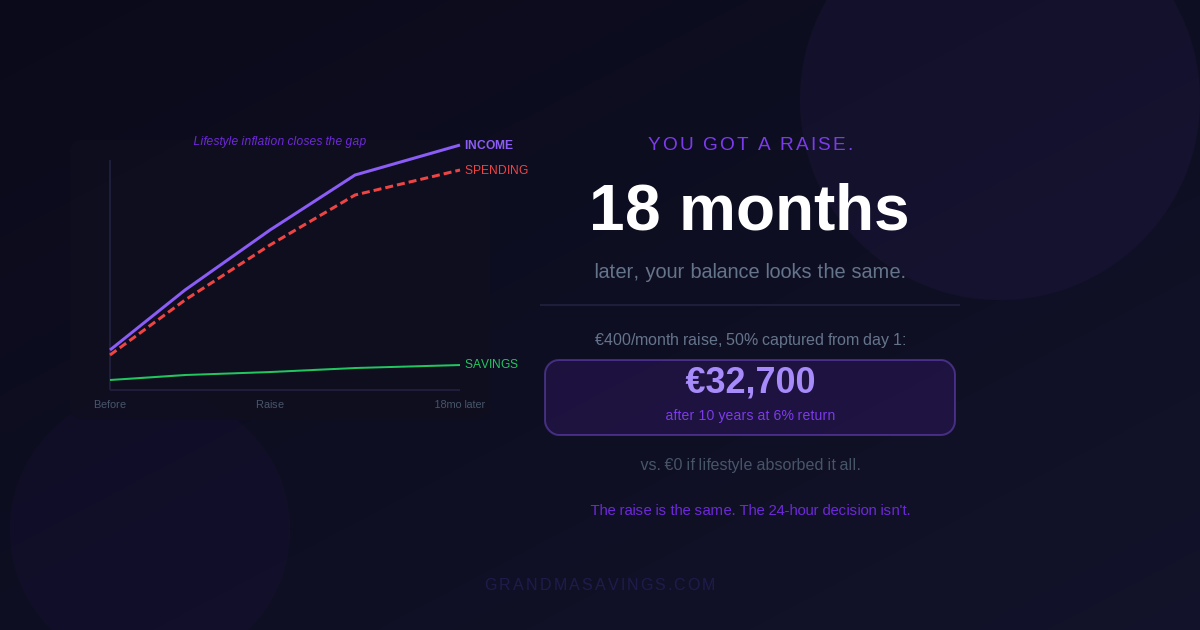
You Got a Pay Rise 18 Months Ago. So Why Does Your Bank Balance Look the Same?
Lifestyle inflation silently absorbs every raise before you can save it. The average pay rise disappears within 90 days without a single conscious decision. Here's what's happening — and the system to stop it.
You remember the email. The number went up — maybe 8%, maybe 12%, maybe a real jump to a new role. You felt it. For a week or two, you thought about what you'd do with the extra money. Pay down the credit card. Finally start that emergency fund. Maybe invest properly.
Eighteen months later, your balance looks about the same as before the raise. Nothing catastrophic happened. No large purchase you can point to. The money just… normalized.
This isn't a discipline failure. It's lifestyle inflation — and it's so systematic that behavioral economists have a name for it: hedonic adaptation. You adapt to your new income level almost immediately, and "normal" resets upward without your conscious participation.
The Problem: Raises Get Absorbed Before You Can Use Them
A €500/month pay rise feels significant. Then the subscriptions get slightly better. The grocery shop gets slightly nicer. The weekends get slightly more expensive. The apartment you looked at before suddenly feels worth it. None of these decisions are unreasonable in isolation. Together, they consume the raise before you ever redirect a euro of it.
Research suggests the average pay rise takes 60–90 days to fully absorb into lifestyle spending. By month four, people report feeling no different financially than before the raise. The income went up. The expenses went up to match.
This is why income alone doesn't build wealth. The same pattern plays out at every income level — people earning €25,000, €60,000, and €150,000 all report feeling "about the same" financially, unless they actively break the cycle.
The Agitation: What That Raise Was Actually Worth
Let's run the numbers on a modest raise — €400/month net.
If it disappears into lifestyle inflation:
- Year 1: €0 saved, spending adjusted upward by €400/month
- Year 5: €0 additional savings, permanently higher expense base
- Year 10: €0 additional net worth from the raise
If 50% is redirected to savings/debt from day one:
- Year 1: €2,400 saved
- At 6% average return, year 5: ~€13,600
- Year 10: ~€32,700
The raise was the same. The outcome is €32,700 different — not because of earning more, but because of where €200/month went in the first 30 days.
The longer you wait to redirect, the more lifestyle inflation has already locked in the spending. Waiting 3 months feels short. But 3 months of normalized higher spending creates habits and commitments (nicer apartment, better subscriptions, higher baseline) that become harder to reverse than to have avoided.
The Solution: The 24-Hour Rule for Pay Rises
The window to act is narrow. Here's the system:
Within 24 hours of your first new paycheck:
-
Calculate the net increase — what actually lands in your account, not gross.
-
Immediately redirect 50% before you spend it. Set up an automatic transfer for that amount to your savings account, debt payment, or investment. Not "I'll move it manually" — automatic, same day as payday.
-
Keep 50% as a lifestyle upgrade. This is important. You earned the raise. Some of it should improve your life. The goal isn't asceticism — it's capturing half before adaptation sets in.
The 50/50 rule works because it's immediate. The lifestyle adjustment happens on the remaining 50%, not the full amount. Your brain adapts to the new normal — but the new normal has a built-in savings rate.
If you already missed the window:
Look for the category where the raise went. Almost always it's one of three places:
- Housing (moved somewhere slightly nicer)
- Food and dining (eating out more, better groceries)
- Subscriptions and convenience (added services you didn't have before)
Find the category. Cut one thing you wouldn't notice losing. Redirect that amount automatically. You don't need to undo the whole lifestyle shift — you just need to recover €100–200/month and automate its direction.
The Compounding Argument
Here's why this matters beyond the immediate numbers:
Every €100/month redirected at age 30, invested at 6% average return:
- By age 40: €16,300
- By age 50: €44,200
- By age 60: €94,800
The €100/month itself isn't significant. The 30-year runway is. A raise in your 30s, half-captured and invested immediately, compounds into something meaningful by your 50s. A raise absorbed entirely into lifestyle compounds into nothing.
The pay rise you got 18 months ago is gone. The next one doesn't have to be.
Track every month's income and expenses in the Savings Tracker — when your next raise hits, you'll see the before/after comparison in real numbers, not guesses.
Found this useful? Share it