Your Savings Account Is Making Your Bank Rich. You're Getting 41 Cents.
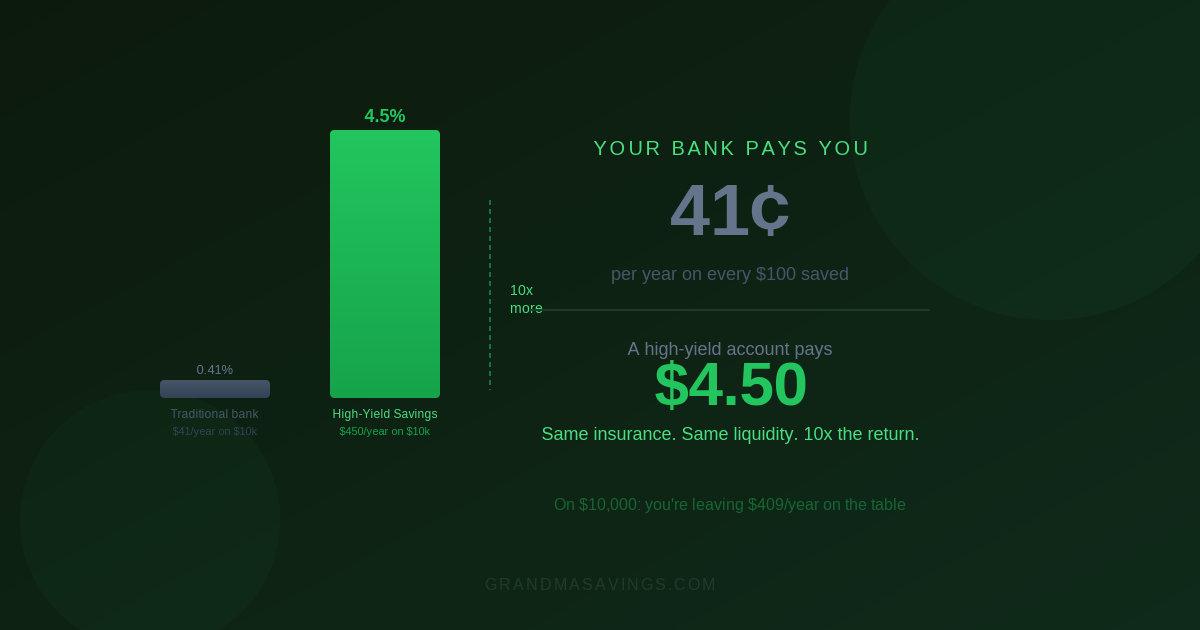
The average savings account pays 0.41% APY. High-yield accounts pay 4.5%. On $10,000, that's a $409 difference — every year — for doing nothing except switching accounts.
You have money in savings. Good. That's more than most people can say.
Now here's the part that stings: your bank is taking that money, lending it out at 7–10% interest, and paying you 0.41% for the privilege. The average traditional savings account in 2026 pays $41 per year on a $10,000 balance.
Meanwhile, the same $10,000 in a high-yield savings account — same FDIC insurance, same liquidity, same cash — pays $410–$500 per year.
You're leaving $369–$459 on the table. Every year. For no reason except inertia.
The Problem: Most People Don't Know the Gap Exists
Banks don't advertise the gap. Why would they? It's not in their interest to tell you that their competitor pays 10x more on the same product.
The result: millions of people hold money in accounts paying near-zero, assuming that's just what savings accounts do. They set up automatic transfers, feel good about saving, and never question whether the account itself is working for or against them.
The interest rate isn't a minor detail. On meaningful balances, it's hundreds of dollars a year in permanent, compounding income you're simply not collecting.
The Math Most Banks Hope You Never Run
| Your balance | Traditional (0.41%) | HYSA (4.5%) | Annual difference |
|---|---|---|---|
| $2,000 | $8/year | $90/year | $82 lost |
| $5,000 | $21/year | $225/year | $204 lost |
| $10,000 | $41/year | $450/year | $409 lost |
| $20,000 | $82/year | $900/year | $818 lost |
That last row — $20,000, $818 per year. That's a short vacation, a car payment, four months of groceries, vanishing silently from your financial picture every year because no one at your bank reminded you to switch.
Over 5 years at those rates, the $20,000 balance earns $410 at 0.41% vs. $4,900 at 4.5%. The difference: $4,490 — just from where you park the money.
Why HYSA Rates Are Still This High in 2026
When the Federal Reserve raised interest rates aggressively in 2022–2023, it became expensive for banks to borrow money. To attract deposits, online banks and neobanks raised savings rates — competing for your cash by offering real returns.
Traditional banks didn't follow. They didn't need to. Their customers didn't leave.
High-yield rates have declined slightly from their 2024 peak as the Fed has begun easing, but they remain historically high. The 4–5% window won't last forever. The opportunity is happening right now.
The Objection: "Is It Safe?"
Yes. Every legitimate HYSA is FDIC-insured up to $250,000 per depositor per bank — the same protection as any traditional savings account. The FDIC doesn't care if your bank has branches or not.
The only difference between a 0.41% account and a 4.5% account is which bank is holding the money — and how much they're willing to pass along to you.
The Switch Takes 20 Minutes. The Return Is Immediate.
Opening an online savings account typically requires:
- Your name, address, SSN
- A funding transfer from your existing account (usually $1 minimum)
- No fee, no minimum balance requirement at most providers
The interest starts accruing the moment money arrives. There's no waiting period, no penalty for also keeping your current account, no trick.
The only thing you lose by switching is the $369–$459/year you've been donating to your bank.
One More Thing: Separate Is Better
There's a psychological benefit to keeping your emergency fund in a different bank than your checking account. The slight friction — 1–2 business days to transfer — is enough to stop you from treating it as spending money. It's accessible when you need it, invisible when you don't.
Your emergency fund should be in a HYSA. Your sinking funds should be in a HYSA. Any cash you're holding for more than 30 days should be in a HYSA.
The era of accepting 0.41% is over.
Already building your emergency fund? The Emergency Fund Calculator tells you exactly how much you need — so you know what balance to aim for in your high-yield account.
Found this useful? Share it